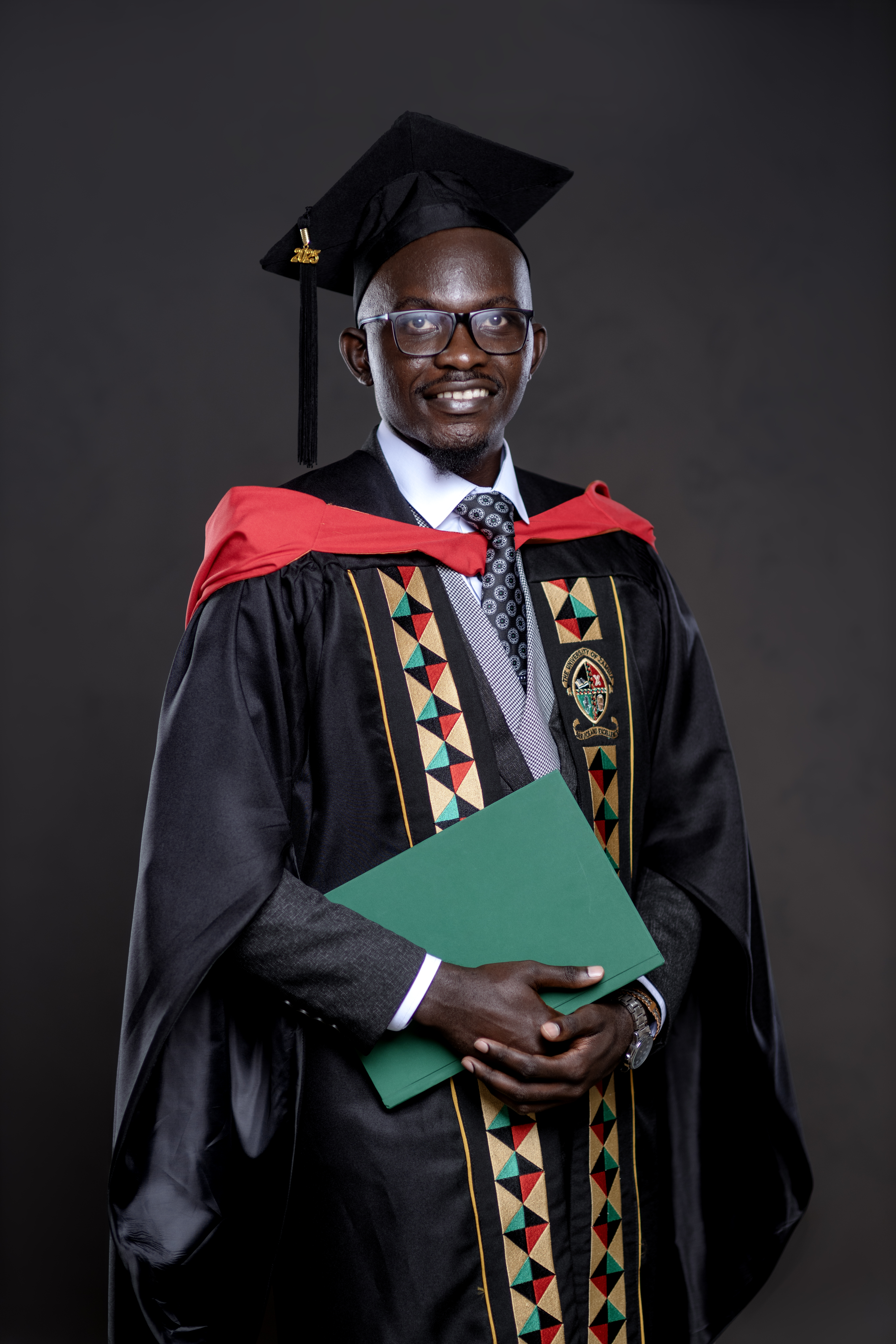
Christopher Shilengwe is among the young scientists whose research careers have been strengthened through the SASSCAL 2.0 Research Programme. Through the TiPPECC (Tipping Points Explained by Climate Change) project, Christopher received a graduate research fellowship from 2023 to 2025, enabling him to pursue a Master of Science by Research in Integrated Water Resources Management at the University of Zambia.
He successfully graduated in 2025 after completing a thesis titled “Downscaling GRACE Missions Groundwater Storage Estimates Using a Machine Learning Model Approach for Climate Change Monitoring in the Upper Zambezi Catchment.” His research focused on improving satellite-based groundwater monitoring in areas where limited ground data is available, providing valuable information for climate change adaptation and water resource management.
Christopher’s academic journey began with a Bachelor of Engineering in Geomatic Engineering, which he completed at the University of Zambia in 2022. He graduated as the best student in the School of Engineering, laying the foundation for his growing career in geospatial science and climate research.
Today, Christopher works as a Geospatial Analyst at Zambia’s National Remote Sensing Centre (NRSC). He applies remote sensing, geospatial technologies and machine learning to support agricultural monitoring, land cover mapping, flood assessment, settlement mapping, land administration and environmental monitoring. His innovative work earned him the Centre’s Labour Day Award for Most Innovative Employee in 2023.
Christopher is now pursuing a Doctor of Philosophy (PhD) in Integrated Water Resources Management at the University of Zambia. His doctoral research uses Geospatial Artificial Intelligence (GeoAI), machine learning and climate projections to improve groundwater forecasting in transboundary aquifers across Southern Africa.
Research Making a Difference
As part of his master’s research, Christopher combined satellite observations from the GRACE and GRACE Follow-On missions with rainfall, temperature, soil moisture, vegetation, evapotranspiration and terrain data. Using machine learning, he produced groundwater storage estimates at a finer spatial resolution of 5 kilometres, improving groundwater monitoring in data-scarce regions.
His research showed how groundwater responds to rainfall variability, droughts and El Niño events. It also identified that groundwater recharge may become limited when seasonal rainfall falls below approximately 614 millimetres. These findings can help improve groundwater planning, drought preparedness and climate change adaptation across the region.
Strong Research Output
Christopher has authored and co-authored several scientific publications in groundwater hydrology, climate variability, environmental management and flood monitoring.
One of his most notable publications, “Machine Learning Downscaling of GRACE/GRACE-FO Data to Capture Spatial-Temporal Drought Effects on Groundwater Storage at a Local Scale Under Data Scarcity,” was published in Environmental Systems Research in 2024 and was recognised as an Editor’s Choice paper.
He also contributed to SASSCAL Policy Brief Issue 12 (May 2026), titled “Securing the Invisible Resource: Leveraging Machine Learning to Address Groundwater Depletion in the Upper Zambezi River Basin.” The policy brief translates his research findings into practical recommendations for groundwater accounting, drought preparedness and groundwater management.
Continuing to Support Sustainable Development
Alongside his PhD studies, Christopher is a Doctoral Research Fellow under the African Centres of Excellence in Water Phase III (ACEWATER III) project. He also works with the International Water Management Institute (IWMI) through the Digital Innovations for Water Secure Africa (DIWASA) project, where he supports crop mapping, irrigation assessment, land and water accounting and crop-yield forecasting using satellite imagery and artificial intelligence.
At the National Remote Sensing Centre, he also contributes to projects that support agriculture, mining, flood management, land administration and natural resource management. In addition, he chairs the Landscape Technical Working Group under the Sustainable Landscape through Integrated Management project.
Looking Ahead
Christopher aims to complete his PhD and continue developing innovative tools that combine satellite observations, artificial intelligence and climate science to improve groundwater management and environmental decision-making.
His long-term goal is to lead multidisciplinary research programmes that strengthen groundwater management, agricultural monitoring, drought preparedness and sustainable natural resource management across Zambia and Southern Africa.
The SASSCAL 2.0 Research Programme, implemented between 2023 and 2025, supported postgraduate research and helped develop the next generation of scientists working to address climate change and environmental challenges across the SASSCAL member countries. The SASSCAL 2.0 Research Programme is funded by the German Federal Ministry of Research, Technology and Space.