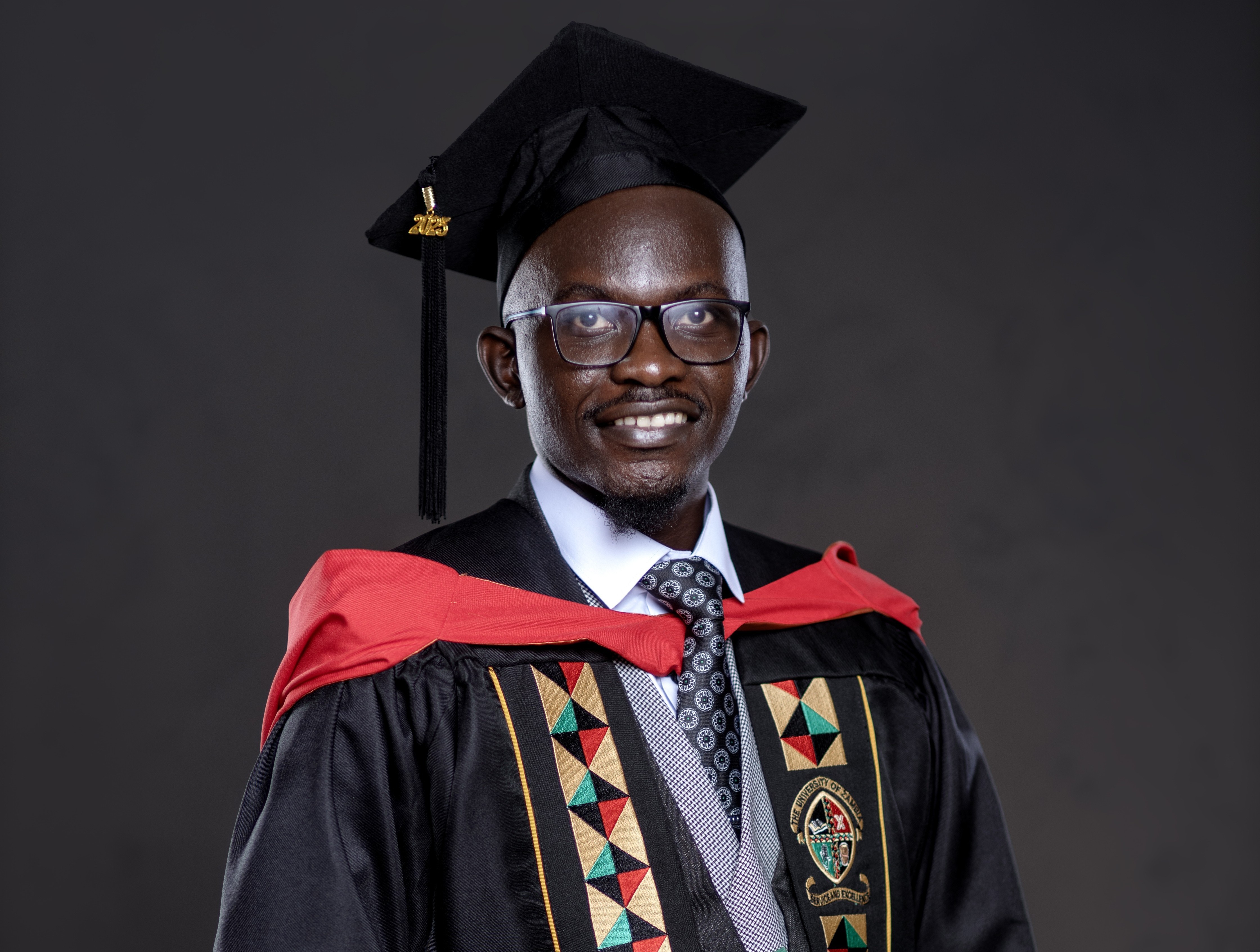
Lusaka, Zambia – Chester Silavwe is one of the young scientists supported through the SASSCAL 2.0 Research Programme under the Farmer Resilience and Melon Crop Diversity in Southern Africa (FRAMe) Project in Zambia.The FRAMe Project worked to strengthen climate resilience by studying, conserving, and promoting indigenous melon varieties. These local melon species are important for sustainable agriculture, food security, and helping farming communities adapt to climate change across Southern Africa.
With support from a SASSCAL 2.0 scholarship, Chester completed his Master of Science in Tropical Ecology and Biodiversity at the University of Zambia in 2026. His research focused on the diversity and fungal disease resistance of Citrullus landraces and their wild relatives in Zambia. The study provides valuable information that can help improve crops, conserve plant genetic resources, and support climate adaptation.
Chester is a botanist, ecologist, and museum professional who is passionate about biodiversity conservation and the sustainable use of natural resources. He also holds a Bachelor of Science with Education (Biological Sciences) from the University of Zambia.
He currently works as an Assistant Keeper of Botany at the Livingstone Museum under the National Museums Board of Zambia. His responsibilities include managing herbarium collections, conserving plant specimens, carrying out biodiversity research, promoting environmental education, and supporting scientific outreach.
During the SASSCAL 2.0 FRAMe Project, Chester carried out field surveys across Zambia to study indigenous melon varieties. He documented their characteristics, recorded their traditional uses by local communities, and assessed their resistance to fungal diseases. His work has improved scientific knowledge of indigenous crop diversity and supports climate-smart agriculture, biodiversity conservation, and the preservation of traditional knowledge.
Before joining the Livingstone Museum, Chester also worked as an Adjunct Lecturer at Eden University and as a Bioscience Tutor at the University of Zambia, where he taught and mentored undergraduate students in biological sciences. He has also contributed to archaeobotanical research through the Basanga Bantu Mobility Project in 2023 and the ZAMBEZI Project in 2026, helping to study ancient plant remains during archaeological excavations.
Chester has presented his research at several regional scientific meetings and SASSCAL conferences, where he shared findings on biodiversity conservation, climate resilience, and sustainable agriculture.
His research has also been published in an international scientific journal. In 2025, he co-authored a paper titled Ethnobotanical Significance of Citrullus Landraces and Wild Relatives in Sesheke, Kaoma, and Mumbwa Districts of Zambia, published in Ethnobotany Research and Applications. The study highlights the traditional uses, cultural importance, and conservation value of indigenous melons in Zambia. https://ethnobotanyjournal.org/index.php/era/article/view/7396
Beyond his research, Chester actively supports environmental conservation. He contributes to biodiversity monitoring, botanical surveys, herbarium management, waterbird monitoring, and museum education programmes that raise awareness about the importance of protecting Zambia’s natural heritage. He also works with researchers and local farming communities to promote the use of indigenous knowledge in biodiversity conservation and climate change adaptation.
Looking ahead, Chester hopes to become a leading plant systematist and conservation scientist in Africa. He plans to pursue a PhD specialising in plant systematics, evolutionary biology, and conservation genetics. He also hopes to build a career as a university lecturer and researcher, mentoring the next generation of scientists while contributing to research that supports biodiversity conservation, climate adaptation, and the sustainable management of Africa’s plant genetic resources.
The SASSCAL 2.0 Research Programme consisted of 13 research projects implemented between 2023 and 2026 with funding from the German Federal Ministry of Research, Technology and Space. Through scholarships and research support, the programme has helped develop a new generation of scientists whose work contributes to sustainable development, climate resilience, and environmental conservation across Southern Africa.